Showing posts with label what. Show all posts
Showing posts with label what. Show all posts
Thursday, December 1, 2016
What is RAID 0 General Information
What is RAID 0 General Information
What is RAID 0
raid0What is RAID 0
What is RAID 0We published an article about RAID 5: "How RAID 5 work? Shorter and
easier to interpret than ever" - and now is the time for a full series. We will try to show you
, in a few words, and interpretation of the shortest record levels of RAID - 0, 1, 1 + 0, 0 + 1, 2, 3, 4, 6
and matrix. Now is the time for RAID 0 - take a look ...
What is RAID 0
We can describe RAID 0 as the connection of the two (or more) physical disks - so as to look like a
logical drive and one engine. In such a case, and ability are all equal to the number of times the disk
in the "smaller" ones ability. ie- if you have two hard drives - 250GB 500GB and, and the size of the
array will be equal to 500 GB.
RAID 0 is called also "bar" or "stripping size" group. This is because it smells data (chart) between
tablets - without symmetry to repeat information. In other words, RAID 0 does not provide data
redundancy. Things, the settlement of data between disks leads to a significant acceleration in
the read and write operations - because of these parallel operations on all disks in the array.
Pros and Cons
The ability of the full group as a whole. Through the implementation of such a solution, it is also
possible to increase the speed of reading and writing (but only compared with one disc).
When we talk about RAID 0, its also necessary to write about the negatives. The first is the issue
of safety data. Is not designed like this method to prevent data loss. This means that a single disk
failure may cause loss of all data contained in the matrix. Moreover, the data can be restored can
be difficult because they are distributed on all disks. It is also impossible to retrieve the "blueprint"
of data. Even when you use a special (and expensive) tools, data recovery can be incomplete and corrupt.
The second thing is the ability. Used even if two disks - 100 GB and 1 TB - will store set equal to
200GB. So the use of disks with different capacities is uneconomical because of the inability to
use the full storage potential.
RAID 0 is useful when
Because the only RAID interest 0 is the write / read speed, we can at one point only the rational
use of it - to build a cheap and effective matrices and solutions use based on the RAID 1 + 0 or RAID 0 + 1.
Check it out for RAID 1 and RAID 0 + 1 and RAID 1 + 0 solutions.
raid0What is RAID 0
What is RAID 0We published an article about RAID 5: "How RAID 5 work? Shorter and
easier to interpret than ever" - and now is the time for a full series. We will try to show you
, in a few words, and interpretation of the shortest record levels of RAID - 0, 1, 1 + 0, 0 + 1, 2, 3, 4, 6
and matrix. Now is the time for RAID 0 - take a look ...
What is RAID 0
We can describe RAID 0 as the connection of the two (or more) physical disks - so as to look like a
logical drive and one engine. In such a case, and ability are all equal to the number of times the disk
in the "smaller" ones ability. ie- if you have two hard drives - 250GB 500GB and, and the size of the
array will be equal to 500 GB.
RAID 0 is called also "bar" or "stripping size" group. This is because it smells data (chart) between
tablets - without symmetry to repeat information. In other words, RAID 0 does not provide data
redundancy. Things, the settlement of data between disks leads to a significant acceleration in
the read and write operations - because of these parallel operations on all disks in the array.
Pros and Cons
The ability of the full group as a whole. Through the implementation of such a solution, it is also
possible to increase the speed of reading and writing (but only compared with one disc).
When we talk about RAID 0, its also necessary to write about the negatives. The first is the issue
of safety data. Is not designed like this method to prevent data loss. This means that a single disk
failure may cause loss of all data contained in the matrix. Moreover, the data can be restored can
be difficult because they are distributed on all disks. It is also impossible to retrieve the "blueprint"
of data. Even when you use a special (and expensive) tools, data recovery can be incomplete and corrupt.
The second thing is the ability. Used even if two disks - 100 GB and 1 TB - will store set equal to
200GB. So the use of disks with different capacities is uneconomical because of the inability to
use the full storage potential.
RAID 0 is useful when
Because the only RAID interest 0 is the write / read speed, we can at one point only the rational
use of it - to build a cheap and effective matrices and solutions use based on the RAID 1 + 0 or RAID 0 + 1.
Check it out for RAID 1 and RAID 0 + 1 and RAID 1 + 0 solutions.
Go to link download

Wednesday, November 30, 2016
What is plagiarism and How it is harmful to all
What is plagiarism and How it is harmful to all

Go to link download
Wednesday, November 16, 2016
What is the Cheapest MSI Gaming Laptop
What is the Cheapest MSI Gaming Laptop
What is the Cheapest MSI Gaming Laptop
What is the Cheapest MSI Gaming Laptop - MSI are a quickly developing maker of Laptops and Netbooks winning various grants around the world. With a concentrate on grant winning item quality and extraordinary client administration they are turning into a profoundly perceived and trusted brand. In case youre searching for a solid laptops. brimming with the most recent engineering and gimmicks, you ought to certainly look at MSI.
 |
| What is the Cheapest MSI Gaming Laptop |
MSI is known for making laptops that offer a prevalent execution, unwavering quality and client experience. They always try to meet their center estimations of "Advancement" and "Style" as to their items. They are well-known all through the world having gotten in excess of 8,000 recompenses from 530 media outlets in fifty separate nations for their item outline.
In the event that you are bad-to-the-bone gamer or are searching for a mixed media gadget, the MSI Gaming arrangement offers the best laptops for you. Their gaming laptops gloat a Turbo Drive Engine (TDE) innovation conveying most extreme force and performance..... Demonstrate Less.
Video overview
Their gaming console has been produced in conjunction with Steelseries conveying an instinctive plan that makes writing agreeable. Sound is given through Dynaudio sound innovation conveying a sensible gaming background.
MSI are satisfied to advertise that they have been granted the prestigious Best Laptop Manufacturer in the 2013 Bit-tech and Custom PC honors. Confronting wild rivalry, MSI secured the grant after their specialized development, fantastic client administration, and exceedingly centered meticulousness which sees them bring new and energizing peculiarities to their scope of laptops. These grants were voted in favor of by the overall population.
Scan our full MSI Laptops extend beneath:
What is the Cheapest MSI Gaming Laptop
Go to link download
Monday, November 14, 2016
RAID 2 RAID 3 RAID 4 What are the characteristics and how does it work And its history
RAID 2 RAID 3 RAID 4 What are the characteristics and how does it work And its history
RAID 2, RAID 3, RAID 4 – what it is, how it works? The history lesson
After RAID 0 and RAID 1 (with RAID 1+0 and RAID 0+1) it is time for RAID 2, 3 and 4. Here we present a small description of the mentioned levels. We hope it will outline a picture of the functionality of these solutions. Although the article is a kind of history lesson – these solutions are no longer used – it is good to be aware of the origins of modern storage technologies.
RAID 2 – the bit-level striping with dedicated Hamming-code parity
In the case of RAID 2 all data are stripped (to the bit levels – not block). Each bit is written on a different drive/stripe. Such a solution requires the use of Hamming code for error correction.
Hamming code is a linear error-correcting code named after its inventor, Richard Hamming. Hamming codes can detect up to d – 1 bit errors, and correct (d – 1) / 2 bit errors, where d is the minimum hamming distance between all pairs in the code words; thus, reliable communication is possible when the Hamming distance between the transmitted and received bit patterns is less than or equal to d. By contrast, the simple parity code cannot correct errors, and can detect only an odd number of errors.
source
The number of discs in RAID 2 used to store information is equal to the logarithm of the number of discs that are protecting the mentioned data. All disks in RAID 2 work as one disk which has a capacity equal to the common capacity of all disks used to store data.

RAID 2
While RAID 2 is being used it is important to synchronize all disks. Such a solution requires that the controller, which makes disks, will spin at the same angular orientation – in other way the index will not be reached at the same time. Disintegration will lead to total uselessness of drives in array.
Such a requirement is not the only drawback. Also the need for long Hamming code generation may prove to be problematic by slowing the whole system down.
The mode of RAID 2 action may be hard to understand. The need for using Hamming code, special controllers for disks – it makes RAID 2 a not very popular solution. But if we think about it in a less pragmatic way, it may prove to be very interesting – mainly due to its modus operandi. It introduces many more complex solutions than RAID 0 and RAID 1. While everything works well, RAID 2 proves to be quite a good solution in area of data security. In case of HDD failure – no matter if it was the disk with data or the Hamming code – any part of the array may be reconstructed by the other disks used.
While it is interesting and it has its advantages, we have not heard about any commercial implementations of RAID 2. Solutions based on it were used only in the initial phase of RAID systems usage – before disks were equipped with their own correction code. Modern HDDs use various correction and optymalising algorithms. That is why the Hamming system has started to be less interesting in the area of professional usage and it is no longer implemented in modern controllers.
RAID 3 – another rare one in practice
RAID 3 works as RAID 0 does – it uses byte-level stripping – but it also uses an additional disk in the array. It is used to store checksums and it supports a special processor in parity codes calculating – so we may call it “the parity disk”.

RAID 3
In RAID 3, configuration data are divided into individual bytes and then saved on a disk. Parity byte is determined for each row of data and saved on the mentioned “parity disk”. In case of failure it allows to recover data by an appropriate calculation of the remaining bytes and parity bytes that correspond with them.
Although RAID 3 is rarely used in practice, it is worth pointing out its advantages. First of all is its resistance to damage of one disk in the arrangement. Secondly, high read speed. Unfortunately, it also has a couple of drawbacks.
The read speed is more than satisfactory but write speed is on the contrary – the reason being the necessity of checksums calculating (even RAID hardware controllers cannot solve this problem). She second disadvantage is a matter of disk failure. When it happens, the whole system will work much slower. What is more, although RAID 3 is resistant to breakdown (in case of failure of one disk in the array), replacing a damaged disk is very costly. A third problem is the disk used for calculating checksums – it is usually the bottleneck in the performance of the entire array.
As can be easily seen, RAID 3 is not a good, reliable or cheap solution. Therefore, as it was mentioned earlier, its use is rare in practice. Systems based on RAID 3 are mostly purposed for implementations where a small number of users refer to the very large files.
RAID 4 – smells like RAID 3 and 5
RAID 4 is very similar to RAID 3. The main difference is the way of sharing data. They are divided in to blocks (16, 32, 64 lub 128 kB) and written on disk s – similar to RAID 0. For each row of written data, any recorded block is written on a parity disk. In short this means that RAID 4 does not strip data at block levels but it uses byte levels for striping (block-level striping with a dedicated parity disk).
There are also similarities in relation to RAID 5, but it confines all parity data to a single drive. RAID 4 does not use distributed parity.

RAID 4
RAID 4 requires at least three disks for complete implementation and configuration. What is more, it also needs hardware support for parity calculations. This makes it possible to recover data by the appropriate mathematical operations.
If we asked: what is RAID 4 for? we would point out one particular need. Such a solution will work very well in the case of really large files – when sequential read and write data process is used. Using RAID 4 for small portions of data would be not a good idea. The reason is the need to carry out modifications of parity blocks for each I/O session. The need for continuous repeating of such an operation would cause large losses of time and slow down a whole system.
RAID 3 and RAID 4 solutions were replaced by RAID 5. You can read about it in an article by Janusz B?k: “How does RAID 5 work? The Shortest and Easiest explanation ever!”
Go to link download
Wednesday, November 9, 2016

Monday, October 24, 2016
What is RAID 2
What is RAID 2
What is RAID ? (2)RAID, short for the "Redundant Array of Independent Disks", is a technology to combine several hard drives into a single storage unit. While the hard drives (called "RAID members") are relatively small, slow, and unreliable, the resulting array can be large, fast, and reliable. However note that while standalone drives are miserable but cheap, the drive array is perfect but expensive. There are different RAID implementations, called RAID levels achieving different goals at different costs. Please read RAID types reference for an overview of these implementations. |
Hardware vs. software RAIDThe RAID can be implemented either using a special controller (hardware RAID), or by an operating system driver (software RAID).
|
Hard drive considerations
|
Go to link download
Tuesday, October 18, 2016
what do you know about Computer Output Units
what do you know about Computer Output Units

Hello my friends we meet together again with another lesson (computer output units).If you see the last lesson it was about (computer input units) and we explain in it all computer input units .Today we will explain every thing about computer output units .Dont worry my friends you will be professional very soon. We start from begging .Lets see our lesson.
Computer Output Units

Today we will start to talk about computer output units .We will talk in details about that in this lesson .Those units responsible for all operations and extraction results, which was implemented by the computer according to the instructions issued by the user .Computer output units is the devices that we connect it to computer and take the output from it like speakers or data like printers or picture like monitor .Computer output units divided to:
- Monitors
- Speakers
- Printers
We will take about every device in details .Lets see

Monitors

Is one of the most important units Computer output so that the screen shows what is entered for computer of letters and numbers and photos etc.. As the screen displays the data previously recorded on the computer.

Speakers

Headphones & speakers are units of data output from the computer. And used in the output of sounds, songs and music. And you can control the degree of high and low sound.

Printers

It is also a unit of output data from the computer. And used in the output data and information (letters - numbers - Photos) printed on the papers.
There is another type of printers called PLOTTERS
PLOTTERS

It is also a unit of output data from the computer. And used in the output graphs and engineering high volumes printed on.

We finish the lesson now .I hope all my friends understand this lesson very well .The next lesson well be about CPU .Thanks my friends....
Engineer: Ashraf Mansour
Egypt

You Can see the last lesson from here
Computer InputUnits


Go to link download
Wednesday, September 28, 2016
What is RAID 0
What is RAID 0
What is RAID?
RAID is an acronym for Redundant Array of Independent (or Inexpensive) Disks. In fact, RAID is the way of combining several independent and relatively small disks into a single storage of a large size. The disks included into the array are called array members. The disks can be combined into the array in different ways which are known as RAID levels. Each of RAID levels has its own characteristics of:
- Fault-tolerance which is the ability to survive of one or several disk failures.
- Performance which shows the change in the read and write speed of the entire array as compared to a single disk.
- The capacity of the array which is determined by the amount of user data that can be written to the array. The array capacity depends on the RAID level and does not always match the sum of the sizes of the RAID member disks. To calculate the capacity of the particular RAID type and a set of the member disks you can use a free online RAID calculator.
How RAID is organized?
Two independent aspects are clearly distinguished in the RAID organization.
- The organization of data in the array (RAID storage techniques: striping, mirroring, parity, combination of them).
- Implementation of each particular RAID installation - hardware or software.
RAID storage techniques
The main methods of storing data in the array are:
- Striping - splitting the flow of data into blocks of a certain size (called "block size") then writing of these blocks across the RAID one by one. This way of data storage affects on the performance.
- Mirroring is a storage technique in which the identical copies of data are stored on the RAID members simultaneously. This type of data placement affects the fault tolerance as well as the performance.
- Parity is a storage technique which is utilized striping and checksum methods. In parity technique, a certain parity function is calculated for the data blocks. If a drive fails, the missing block are recalculated from the checksum, providing the RAID fault tolerance.
All the existing RAID types are based on striping, mirroring, parity, or combination of these storage techniques.
RAID levels
- RAID 0 - based on striping. This RAID level doesnt provide fault tolerance but increases the system performance (high read and write speed).
- RAID 1 - utilizes mirroring technique, increases read speed in some cases, and provides fault tolerance in the loss of no more than one member disk.
- RAID 0+1 - based on the combination of striping and mirroring techniques. This RAID level inherits RAID 0 performance and RAID 1 fault tolerance.
- RAID1E - uses both striping and mirroring techniques, can survive a failure of one member disk or any number of nonadjacent disks. There are three subtypes of RAID 1E layout: near, interleaved, and far. More information and diagrams on the RAID 1E page.
- RAID 5 - utilizes both striping and parity techniques. Provides the read speed improvement as in RAID 0 approximately, survives the loss of one RAID member disk.
- RAID 5E - a variation of RAID 5 layout the only difference of which is an integrated spare space allowing to rebuild a failed array immediately in case of a disk failure. Read more on the RAID5E page.
- RAID 5 with delayed parity - pretty similar to basic RAID 5 layout, but uses nonstandard scheme of striping. More information about RAID5 with delayed parity.
- RAID 6 - similar to RAID 5 but uses two different parity functions. The read speed is the same as in RAID 5.
RAID implementations
RAID can be created by two different ways:
- with the use of operating system drivers, so called software RAID;
- with the use of special hardware, so called hardware RAID.
Software RAID
Software RAID is one of the cheapest RAID solutions.
Nowadays, almost any of the operating systems has a built-in capability to create RAID, though not for all RAID levels. Thus, Windows home editions allow user to create only RAID 0, while RAID 1 and RAID 5 can be created only using Windows server editions. RAID layout created by means of Windows is inseparably linked with the host operating system and so its partitions cannot be used, for example, in dual boot.
Software RAID is created based on the users computer and therefore it uses the host system CPU for implementation. It should be noted, that in case of RAID levels 0 and 1, CPU load is negligible, but for the RAID types based on parity, CPU load can vary from 1 to 5 percent depending on CPU power and the number of the disks, which is also negligible for practical purposes.
There are certain limitations on the use of the software RAID to boot the system. Only RAID 1 can contain boot partition, while system boot is impossible with a software RAID 5 and RAID 0.
Keep in mind that in most cases software RAID doesnt implement the hot-swapping and so it cannot be used where continuous availability is required.
Hardware RAID
Hardware RAID is created using separate hardware. Basically there are two options:
- inexpensive RAID chip possibly built into the motherboard,
- more expensive option with a complex standalone RAID controller. Such controllers can be equipped with their own CPU, battery-backed up cache memory, and they typically support hot-swapping.
A hardware RAID has some advantages over a software RAID, such as:
- doesnt use CPU of the host computer;
- allows user to create boot partitions;
- handles errors better, since communicates with the devices directly;
- supports hot-swapping.
Go to link download
Monday, September 19, 2016
What are the hidden costs
What are the hidden costs
What are the hidden costs?
RAID recovery is not finished when parameters are detected. Once the parameters are detected you have to either
- write a copy of the RAID somewhere if all RAIDs content is needed
- use regular data recovery program if only some files are needed.
If you have enough unused hard disks or a license of any data recovery program compatible with ReclaiMe Free RAID Recovery, then no hidden costs are involved. If neither of these is available, you will have to pay for either a storage, or a data recovery software.
Our RAID Recovery software works with
- hard drives (internal and external),
- disk image files,
- disks from hardware and software RAIDs,
- disks from most all NAS devices.
Note: ReclaiMe Free RAID Recovery software needs Windows to run. It does not run on Apple Mac or Linux environment.
Difference between ReclaiMe File Recovery and ReclaiMe Free RAID Recovery

Go to link download
Thursday, August 18, 2016
What are the Weakness of Windows 8 1
What are the Weakness of Windows 8 1
What are the Weakness of Windows 8.1
What are the Weakness of Windows 8.1 - Project Zero is a Google activity that targets shortcomings in distinctive programmings that are at present accessible in the business sector, in the wake of deciding the conceivable helplessness of those projects it is then appeared for its individual merchant for them to have the capacity to fix it before programmers can utilize those vulnerabilities to endeavor their frameworks. On the other hand, Google just gives the engineer a 90-day restrain keeping in mind the end goal to make a patch to alter the issue and after that Google will distribute the escape clause alongside codes that could misuse it. Tragically for Microsoft the 90-day window has effectively terminated and the tech goliath has yet to create a patch for the located issues on its product.
 |
| What are the Weakness of Windows 8.1 |
A scientist taking a shot at the Windows 8.1 figured out that a vast security opening is open for programmers to endeavor. The helplessness will permit low-level clients, for example, Guests to get to and pick up Administrator rights, consequently providing for them full control and access to touchy and potentially harming capacities. After Google Zero group educated Microsoft of the conceivable security shortcoming in their framework, Microsoft was given precisely 90 days to make a patch to settle it. Tragically for Microsoft, no patch was made and Google distributed the security defect days back, right on timetable.
 |
| windows 8.1 |
A few masters say that Google is accomplishing more damage than great with its Project Zero, particularly calling attention to the adaptability of its distributed due date. The individuals who are on Googles side say that the 90-day window is reasonable and sensible enough for any designer or merchant to make a patch for their products own particular shortcomings. Others are guiding fingers toward Microsoft for their absence of consideration concerning their own particular security provisos. In this way, no hacks were accounted for to have utilized the found escape clause and as per Microsofts official explanation with respect to the matter, they are right now "attempting to discharge a security redesign to address an Elevation of Privilege issue."
What are the Weakness of Windows 8.1
Go to link download
What is RAID 1 RAID 1 0 and RAID 0 1
What is RAID 1 RAID 1 0 and RAID 0 1
What are RAID 1, RAID 1+0 and RAID 0+1

What are RAID 1, RAID 1+0 and RAID 0+1
What is RAID 1, RAID 1 + 0 and RAID 0 + 1
This is the second article in a series of our RAID. We hope to show - in the easiest possible way - What is RAID, and the idea of ??it and how it works. We wrote about RAID 0. Now is the time for RAID 1, RAID 0 + 1 and RAID 1 + 0.
What is RAID 1 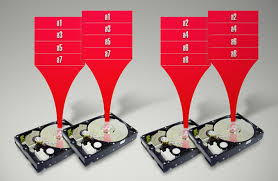
What is RAID 1, RAID 1 + 0 and RAID 0 + 1RAID 1 (copies) - The basic idea of ??this solution is to repeat (copies) of two or more disks. This means that while the use of RAID 1, is created a replica (or mirror) on two or more disks. This solution gives a good read performance and reliability, but you should defragment storage capacity. The reason for this is that the total storage must be equal to the capacity of the smallest drive. Ie: in the case of a group consisting of 3 tablets - 250GM, 500GB and 1TB - will be usable space equal to 250 GB.
Why RAID 1
RAID 1 is the easy way to secure data and to maintain the reasonable value of reading, writing and access speed. Adoption of this strategy allows to maximize the full benefit of these processes. While it is sequential, and the speed of public writing is equal for all write operations from each drive in the array. It is a process at one time, and write operations take place in parallel with all of the drives - which means that the duration of the registration period is equal to the disk to run slower.
It is also possible to prepare this strategy to the process of reading. And can be serially - even reading speed can be almost equal to RAID 0 or it can only be done from the selected drives. The second solution is used when there are significant differences between the read speeds of each drive in the array.
But back to the Pros - The possibility to increase reading speed and reduce access time is the main advantage. The second is the integrity of the data. Wikipedia gives us a good and simple example:
Consider RAID 1 with two similar models of the drive with a 5% probability that the disk will fail within three years. Provided that the failure to be statistically independent, the probability of each of the disk failure during the three-year period is 0.25%. Thus, the possibility of losing all the data is 0.25% over a period of three years if nothing is done to the group. If the first disk failure is never replace, then there is a chance of 5% will be data loss. If only one of the disks fails, no data will be lost. As long as they failed disk is replaced by a second disk fails, the data safe.
However, since the two tablets are used identical and since the patterns used are also identical, their failure can not be assumed to be independent. Thus, the possibility of losing all the data, if not replace the first disk fails, you may be much higher than 5%.
In practice, a good management system in the above is irrelevant because it will not be hard to ignore the failed disk, but will be replaced. Is determined by the reliability of public order by the prospect of remaining engine will continue to work during the reform period, and this is the total time it takes to detect the failure, and the replacement of the hard drive failed, and that the campaign to rebuild. If, for example, it takes one hour to replace the failed drive is replaced, and the public knows the reliability of the system by the possibility of engine and the remaining disks operate for one hour without fail.
Source
Its also easy to see, and the possibility of data loss really small. This is the biggest advantage for RAID 1 - to allow for the issuance of a quick resolution to the rare possibility of data loss through disk failure.
However, there are also some drawbacks. As mentioned, a full range of storage capacity equal to the storage capacity of the smallest related disk. The second thing is something we can call and RAID 1 can prevent data loss due to disk failure, but in the virus or human factors case of "instant of writing and change the process." (Ie: accidental deletion of data) RAID 1 is useless. Changes at first will (two) in the disk array also take place in the second - immediately or soon. Will be the wrong one loss, malware or anything else and data.
What is RAID 0 + 1 and RAID 1 + 0

RAID 0 + 1 arrays means implemented in RAID 1, which is 0 RAID arrays elements. This implementation has speed RAID 0, RAID 1 safety benefits. It is also much easier to implement than RAID 3, RAID 5 or RAID 6. The main disadvantage of this solution is cost.
RAID 1 + 0
RAID 0 + 1
The implementation of RAID 1 + 0 set as RAID 0, who are RAID 1. It combines elements of the same advantages of RAID 0 (speed) and RAID 1 (safety), but in a different way. RAID 1 + 0 creates a large strip of small mirrors. After a disk failure, while being replaced, and the rebuilding of only a small part of a complete set. Unfortunately, it has the same drawback as that of RAID 0 + 1 - the cost of implementation.
Go to link download
Subscribe to:
Posts (Atom)