Showing posts with label is. Show all posts
Showing posts with label is. Show all posts
Thursday, December 1, 2016
What is RAID 0 General Information
What is RAID 0 General Information
What is RAID 0
raid0What is RAID 0
What is RAID 0We published an article about RAID 5: "How RAID 5 work? Shorter and
easier to interpret than ever" - and now is the time for a full series. We will try to show you
, in a few words, and interpretation of the shortest record levels of RAID - 0, 1, 1 + 0, 0 + 1, 2, 3, 4, 6
and matrix. Now is the time for RAID 0 - take a look ...
What is RAID 0
We can describe RAID 0 as the connection of the two (or more) physical disks - so as to look like a
logical drive and one engine. In such a case, and ability are all equal to the number of times the disk
in the "smaller" ones ability. ie- if you have two hard drives - 250GB 500GB and, and the size of the
array will be equal to 500 GB.
RAID 0 is called also "bar" or "stripping size" group. This is because it smells data (chart) between
tablets - without symmetry to repeat information. In other words, RAID 0 does not provide data
redundancy. Things, the settlement of data between disks leads to a significant acceleration in
the read and write operations - because of these parallel operations on all disks in the array.
Pros and Cons
The ability of the full group as a whole. Through the implementation of such a solution, it is also
possible to increase the speed of reading and writing (but only compared with one disc).
When we talk about RAID 0, its also necessary to write about the negatives. The first is the issue
of safety data. Is not designed like this method to prevent data loss. This means that a single disk
failure may cause loss of all data contained in the matrix. Moreover, the data can be restored can
be difficult because they are distributed on all disks. It is also impossible to retrieve the "blueprint"
of data. Even when you use a special (and expensive) tools, data recovery can be incomplete and corrupt.
The second thing is the ability. Used even if two disks - 100 GB and 1 TB - will store set equal to
200GB. So the use of disks with different capacities is uneconomical because of the inability to
use the full storage potential.
RAID 0 is useful when
Because the only RAID interest 0 is the write / read speed, we can at one point only the rational
use of it - to build a cheap and effective matrices and solutions use based on the RAID 1 + 0 or RAID 0 + 1.
Check it out for RAID 1 and RAID 0 + 1 and RAID 1 + 0 solutions.
raid0What is RAID 0
What is RAID 0We published an article about RAID 5: "How RAID 5 work? Shorter and
easier to interpret than ever" - and now is the time for a full series. We will try to show you
, in a few words, and interpretation of the shortest record levels of RAID - 0, 1, 1 + 0, 0 + 1, 2, 3, 4, 6
and matrix. Now is the time for RAID 0 - take a look ...
What is RAID 0
We can describe RAID 0 as the connection of the two (or more) physical disks - so as to look like a
logical drive and one engine. In such a case, and ability are all equal to the number of times the disk
in the "smaller" ones ability. ie- if you have two hard drives - 250GB 500GB and, and the size of the
array will be equal to 500 GB.
RAID 0 is called also "bar" or "stripping size" group. This is because it smells data (chart) between
tablets - without symmetry to repeat information. In other words, RAID 0 does not provide data
redundancy. Things, the settlement of data between disks leads to a significant acceleration in
the read and write operations - because of these parallel operations on all disks in the array.
Pros and Cons
The ability of the full group as a whole. Through the implementation of such a solution, it is also
possible to increase the speed of reading and writing (but only compared with one disc).
When we talk about RAID 0, its also necessary to write about the negatives. The first is the issue
of safety data. Is not designed like this method to prevent data loss. This means that a single disk
failure may cause loss of all data contained in the matrix. Moreover, the data can be restored can
be difficult because they are distributed on all disks. It is also impossible to retrieve the "blueprint"
of data. Even when you use a special (and expensive) tools, data recovery can be incomplete and corrupt.
The second thing is the ability. Used even if two disks - 100 GB and 1 TB - will store set equal to
200GB. So the use of disks with different capacities is uneconomical because of the inability to
use the full storage potential.
RAID 0 is useful when
Because the only RAID interest 0 is the write / read speed, we can at one point only the rational
use of it - to build a cheap and effective matrices and solutions use based on the RAID 1 + 0 or RAID 0 + 1.
Check it out for RAID 1 and RAID 0 + 1 and RAID 1 + 0 solutions.
Go to link download

Wednesday, November 30, 2016
What is plagiarism and How it is harmful to all
What is plagiarism and How it is harmful to all

Go to link download
Thursday, November 17, 2016
Importance Of Android App Developer Why It Is Profitable Profession
Importance Of Android App Developer Why It Is Profitable Profession

Article From : www.freebloggertricks.com
So you are looking forward to be a Android App Developer and surprise why is it an honest career option? this can be your browse. per a recent job survey, theres an increase of forty p.c in job openings for Android developers. Attributable to this rise within the demand of Android developers, a bunch IT coaching institutes across the town square measure introducing dedicated info and categories for Android app development courses. one in every of these institute will be your temple of education if you are looking forward to a promising career in Android application development.
Android is one in every of the foremost used OS in tablets and sensible phones nowadays. Attributable to this rise in its usability and high commercialism of Android primarily based mobile devices, demand of Android app developers has conjointly gone up. the foremost reason for this, square measure the wonderful options, apps, and games created accessible to the user on Android platform. Therefore if youre keen on all those apps and games on your phone and surprise however it works, then this might be a cool career choice for you.
Lets take a glance at some statistics that may informed you higher together with your decision:
Android was born in between 2005-2006 and later brought into existence in 2007 by Google and since then its growing at a quicker pace. Today, each alternative phone is running on Android platform. each half dozen out of ten mobile devices square measure found to be Android primarily based devices. Presently, Android holds forty ninth of the entire market share that shows that there square measure around a hundred and eighty million Android smartphones within the market.
Lets see what square measure the key areas in Android development wherever youll get your hands on:
1. Graphical user interface coming up with
2. Application Programming
3. Implementation
4. Mobile Game Developer
5. Android Mobile Application Project Manager
What you wish to grasp before you start:
1. Java Programming Language: Android Development lives with and dies while not Java. Its sure enough not a troublesome artificial language to be told if you recognize some cryptography basics.
2. XML: Xml is employed for declare UI parts in humanoid apps. Also, its been wide used with alternative programming languages too. Knowing XML will build your job plenty easier here.
3. Development Environment: this can be wherever app development tools comes into play. Eclipse is one such tool that is wide utilized by android app developers and conjointly suggested by high humanoid development firms. youll conjointly ought to setup humanoid SDK before you begin cryptography. the most effective half here is that you simply will notice one package simply on-line that features everything you wish for humanoid development.
Some fast points why Android App Development may be a hot career option:
1. Sensible Pay Scale
2. Quickest growing mobile platform
3. Plenty of career growth
4. Get to figure with high Android Development Company
5. Youll freelance anytime.
Last Words: Android app developer may be a sensible career choice if you are looking forward to a difficult and growing career.
Nancy Griffni may be a technical content author and a gizmo geek.She likes to compose latest technology, gadgets and mobile reviews.Currently she is functioning with Xicom Technologies, a number one humanoid Development Company in India. If you are looking to rent humanoid Developers, be happy to induce in grips with Xicom Technologies.
Go to link download
Wednesday, November 16, 2016
What is the Cheapest MSI Gaming Laptop
What is the Cheapest MSI Gaming Laptop
What is the Cheapest MSI Gaming Laptop
What is the Cheapest MSI Gaming Laptop - MSI are a quickly developing maker of Laptops and Netbooks winning various grants around the world. With a concentrate on grant winning item quality and extraordinary client administration they are turning into a profoundly perceived and trusted brand. In case youre searching for a solid laptops. brimming with the most recent engineering and gimmicks, you ought to certainly look at MSI.
 |
| What is the Cheapest MSI Gaming Laptop |
MSI is known for making laptops that offer a prevalent execution, unwavering quality and client experience. They always try to meet their center estimations of "Advancement" and "Style" as to their items. They are well-known all through the world having gotten in excess of 8,000 recompenses from 530 media outlets in fifty separate nations for their item outline.
In the event that you are bad-to-the-bone gamer or are searching for a mixed media gadget, the MSI Gaming arrangement offers the best laptops for you. Their gaming laptops gloat a Turbo Drive Engine (TDE) innovation conveying most extreme force and performance..... Demonstrate Less.
Video overview
Their gaming console has been produced in conjunction with Steelseries conveying an instinctive plan that makes writing agreeable. Sound is given through Dynaudio sound innovation conveying a sensible gaming background.
MSI are satisfied to advertise that they have been granted the prestigious Best Laptop Manufacturer in the 2013 Bit-tech and Custom PC honors. Confronting wild rivalry, MSI secured the grant after their specialized development, fantastic client administration, and exceedingly centered meticulousness which sees them bring new and energizing peculiarities to their scope of laptops. These grants were voted in favor of by the overall population.
Scan our full MSI Laptops extend beneath:
What is the Cheapest MSI Gaming Laptop
Go to link download
Wednesday, November 9, 2016

Monday, October 24, 2016
What is RAID 2
What is RAID 2
What is RAID ? (2)RAID, short for the "Redundant Array of Independent Disks", is a technology to combine several hard drives into a single storage unit. While the hard drives (called "RAID members") are relatively small, slow, and unreliable, the resulting array can be large, fast, and reliable. However note that while standalone drives are miserable but cheap, the drive array is perfect but expensive. There are different RAID implementations, called RAID levels achieving different goals at different costs. Please read RAID types reference for an overview of these implementations. |
Hardware vs. software RAIDThe RAID can be implemented either using a special controller (hardware RAID), or by an operating system driver (software RAID).
|
Hard drive considerations
|
Go to link download
Wednesday, September 28, 2016
What is RAID 0
What is RAID 0
What is RAID?
RAID is an acronym for Redundant Array of Independent (or Inexpensive) Disks. In fact, RAID is the way of combining several independent and relatively small disks into a single storage of a large size. The disks included into the array are called array members. The disks can be combined into the array in different ways which are known as RAID levels. Each of RAID levels has its own characteristics of:
- Fault-tolerance which is the ability to survive of one or several disk failures.
- Performance which shows the change in the read and write speed of the entire array as compared to a single disk.
- The capacity of the array which is determined by the amount of user data that can be written to the array. The array capacity depends on the RAID level and does not always match the sum of the sizes of the RAID member disks. To calculate the capacity of the particular RAID type and a set of the member disks you can use a free online RAID calculator.
How RAID is organized?
Two independent aspects are clearly distinguished in the RAID organization.
- The organization of data in the array (RAID storage techniques: striping, mirroring, parity, combination of them).
- Implementation of each particular RAID installation - hardware or software.
RAID storage techniques
The main methods of storing data in the array are:
- Striping - splitting the flow of data into blocks of a certain size (called "block size") then writing of these blocks across the RAID one by one. This way of data storage affects on the performance.
- Mirroring is a storage technique in which the identical copies of data are stored on the RAID members simultaneously. This type of data placement affects the fault tolerance as well as the performance.
- Parity is a storage technique which is utilized striping and checksum methods. In parity technique, a certain parity function is calculated for the data blocks. If a drive fails, the missing block are recalculated from the checksum, providing the RAID fault tolerance.
All the existing RAID types are based on striping, mirroring, parity, or combination of these storage techniques.
RAID levels
- RAID 0 - based on striping. This RAID level doesnt provide fault tolerance but increases the system performance (high read and write speed).
- RAID 1 - utilizes mirroring technique, increases read speed in some cases, and provides fault tolerance in the loss of no more than one member disk.
- RAID 0+1 - based on the combination of striping and mirroring techniques. This RAID level inherits RAID 0 performance and RAID 1 fault tolerance.
- RAID1E - uses both striping and mirroring techniques, can survive a failure of one member disk or any number of nonadjacent disks. There are three subtypes of RAID 1E layout: near, interleaved, and far. More information and diagrams on the RAID 1E page.
- RAID 5 - utilizes both striping and parity techniques. Provides the read speed improvement as in RAID 0 approximately, survives the loss of one RAID member disk.
- RAID 5E - a variation of RAID 5 layout the only difference of which is an integrated spare space allowing to rebuild a failed array immediately in case of a disk failure. Read more on the RAID5E page.
- RAID 5 with delayed parity - pretty similar to basic RAID 5 layout, but uses nonstandard scheme of striping. More information about RAID5 with delayed parity.
- RAID 6 - similar to RAID 5 but uses two different parity functions. The read speed is the same as in RAID 5.
RAID implementations
RAID can be created by two different ways:
- with the use of operating system drivers, so called software RAID;
- with the use of special hardware, so called hardware RAID.
Software RAID
Software RAID is one of the cheapest RAID solutions.
Nowadays, almost any of the operating systems has a built-in capability to create RAID, though not for all RAID levels. Thus, Windows home editions allow user to create only RAID 0, while RAID 1 and RAID 5 can be created only using Windows server editions. RAID layout created by means of Windows is inseparably linked with the host operating system and so its partitions cannot be used, for example, in dual boot.
Software RAID is created based on the users computer and therefore it uses the host system CPU for implementation. It should be noted, that in case of RAID levels 0 and 1, CPU load is negligible, but for the RAID types based on parity, CPU load can vary from 1 to 5 percent depending on CPU power and the number of the disks, which is also negligible for practical purposes.
There are certain limitations on the use of the software RAID to boot the system. Only RAID 1 can contain boot partition, while system boot is impossible with a software RAID 5 and RAID 0.
Keep in mind that in most cases software RAID doesnt implement the hot-swapping and so it cannot be used where continuous availability is required.
Hardware RAID
Hardware RAID is created using separate hardware. Basically there are two options:
- inexpensive RAID chip possibly built into the motherboard,
- more expensive option with a complex standalone RAID controller. Such controllers can be equipped with their own CPU, battery-backed up cache memory, and they typically support hot-swapping.
A hardware RAID has some advantages over a software RAID, such as:
- doesnt use CPU of the host computer;
- allows user to create boot partitions;
- handles errors better, since communicates with the devices directly;
- supports hot-swapping.
Go to link download
Wednesday, September 14, 2016
the disk is write protected Apa nak buat
the disk is write protected Apa nak buat


Apa nak buat...??
Muat Turun Fail dibawah..dan buka...Tekan Format.....
Muat Turun Repair write protected_v2.9.1.1
Muat Turun Repair write protected_v2.9.1.8A
password : downloaddriveranda

Done!!
Go to link download
Saturday, September 3, 2016
Microsoft is all in on big data
Microsoft is all in on big data

Microsoft is all in on big data
Analytical DBMS: SQL Server 2012 Parallel Data Warehouse (PDW).
In-memory DBMS: SQL Server 2014 In-Memory OLTP (option available with SQL Server 2014, set for release by second quarter of 2014).
Stream-processing technology: Microsoft StreamInsight.
Hadoop distribution: HDInsight/Windows Azure HDInsight Service (based on Hortonworks Data Platform).
Hardware/software systems: Dell Parallel Data Warehouse Appliance, HP Enterprise Parallel Data Warehouse Appliance.
Analytical DBMS: SQL Server 2012 Parallel Data Warehouse (PDW).
In-memory DBMS: SQL Server 2014 In-Memory OLTP (option available with SQL Server 2014, set for release by second quarter of 2014).
Stream-processing technology: Microsoft StreamInsight.
Hadoop distribution: HDInsight/Windows Azure HDInsight Service (based on Hortonworks Data Platform).
Hardware/software systems: Dell Parallel Data Warehouse Appliance, HP Enterprise Parallel Data Warehouse Appliance.
Microsofts vision is to provide a complete information production process for data -- all data. It has embraced Hadoop for high-scale and unstructured data, partnering to build HDInsight based on the Hortonworks Data Platform. HDInsight is available as a service on Microsofts Azure Cloud or can be used on premises. You manage HDInsight with Microsoft Systems Center, virtualize its resources with Microsoft Virtual Machine Manager, and control access to its data with Active Directory. Drawing from the hundreds of terabytes or petabytes in Hadoop, Microsoft customers can then analyze boiled-down result sets in SQL Server Parallel Data Warehouse. PDW is a massively parallel processing DBMS that includes a PolyBase access layer for combining non-relational data from Hadoop and structured data from a PDW warehouse or mart.
Microsoft analyzes streaming data with Microsoft StreamInsight, and it handles high-volume machine-data and technical analysis with its High Performance Computing Cluster. No matter how complex or high-scale the challenge, Microsoft sees the analysis getting back to SQL Server Analysis Services, Information Integration Services, Reporting Services, Master Data Services, and the worlds most popular BI tool, Office Excel with PowerPivot for in-memory analysis and PowerView for data visualization.
Theres no doubt that Microsoft is amassing all the pieces, but its early days for HDInsight, and we still dont see many PDW deployments after three years in the market. Were watching to see whether the release of SQL Server 2014, expected in the first half of this year, and the fast growth of the Windows Azure cloud, with its public data market and HDInsight service, help elevate Microsofts name in enterprise big data.
Go to link download
Thursday, August 18, 2016
What is RAID 1 RAID 1 0 and RAID 0 1
What is RAID 1 RAID 1 0 and RAID 0 1
What are RAID 1, RAID 1+0 and RAID 0+1

What are RAID 1, RAID 1+0 and RAID 0+1
What is RAID 1, RAID 1 + 0 and RAID 0 + 1
This is the second article in a series of our RAID. We hope to show - in the easiest possible way - What is RAID, and the idea of ??it and how it works. We wrote about RAID 0. Now is the time for RAID 1, RAID 0 + 1 and RAID 1 + 0.
What is RAID 1 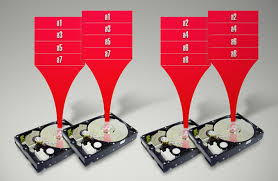
What is RAID 1, RAID 1 + 0 and RAID 0 + 1RAID 1 (copies) - The basic idea of ??this solution is to repeat (copies) of two or more disks. This means that while the use of RAID 1, is created a replica (or mirror) on two or more disks. This solution gives a good read performance and reliability, but you should defragment storage capacity. The reason for this is that the total storage must be equal to the capacity of the smallest drive. Ie: in the case of a group consisting of 3 tablets - 250GM, 500GB and 1TB - will be usable space equal to 250 GB.
Why RAID 1
RAID 1 is the easy way to secure data and to maintain the reasonable value of reading, writing and access speed. Adoption of this strategy allows to maximize the full benefit of these processes. While it is sequential, and the speed of public writing is equal for all write operations from each drive in the array. It is a process at one time, and write operations take place in parallel with all of the drives - which means that the duration of the registration period is equal to the disk to run slower.
It is also possible to prepare this strategy to the process of reading. And can be serially - even reading speed can be almost equal to RAID 0 or it can only be done from the selected drives. The second solution is used when there are significant differences between the read speeds of each drive in the array.
But back to the Pros - The possibility to increase reading speed and reduce access time is the main advantage. The second is the integrity of the data. Wikipedia gives us a good and simple example:
Consider RAID 1 with two similar models of the drive with a 5% probability that the disk will fail within three years. Provided that the failure to be statistically independent, the probability of each of the disk failure during the three-year period is 0.25%. Thus, the possibility of losing all the data is 0.25% over a period of three years if nothing is done to the group. If the first disk failure is never replace, then there is a chance of 5% will be data loss. If only one of the disks fails, no data will be lost. As long as they failed disk is replaced by a second disk fails, the data safe.
However, since the two tablets are used identical and since the patterns used are also identical, their failure can not be assumed to be independent. Thus, the possibility of losing all the data, if not replace the first disk fails, you may be much higher than 5%.
In practice, a good management system in the above is irrelevant because it will not be hard to ignore the failed disk, but will be replaced. Is determined by the reliability of public order by the prospect of remaining engine will continue to work during the reform period, and this is the total time it takes to detect the failure, and the replacement of the hard drive failed, and that the campaign to rebuild. If, for example, it takes one hour to replace the failed drive is replaced, and the public knows the reliability of the system by the possibility of engine and the remaining disks operate for one hour without fail.
Source
Its also easy to see, and the possibility of data loss really small. This is the biggest advantage for RAID 1 - to allow for the issuance of a quick resolution to the rare possibility of data loss through disk failure.
However, there are also some drawbacks. As mentioned, a full range of storage capacity equal to the storage capacity of the smallest related disk. The second thing is something we can call and RAID 1 can prevent data loss due to disk failure, but in the virus or human factors case of "instant of writing and change the process." (Ie: accidental deletion of data) RAID 1 is useless. Changes at first will (two) in the disk array also take place in the second - immediately or soon. Will be the wrong one loss, malware or anything else and data.
What is RAID 0 + 1 and RAID 1 + 0

RAID 0 + 1 arrays means implemented in RAID 1, which is 0 RAID arrays elements. This implementation has speed RAID 0, RAID 1 safety benefits. It is also much easier to implement than RAID 3, RAID 5 or RAID 6. The main disadvantage of this solution is cost.
RAID 1 + 0
RAID 0 + 1
The implementation of RAID 1 + 0 set as RAID 0, who are RAID 1. It combines elements of the same advantages of RAID 0 (speed) and RAID 1 (safety), but in a different way. RAID 1 + 0 creates a large strip of small mirrors. After a disk failure, while being replaced, and the rebuilding of only a small part of a complete set. Unfortunately, it has the same drawback as that of RAID 0 + 1 - the cost of implementation.
Go to link download
Subscribe to:
Posts (Atom)